Psychological aspects
Analysis of the Individual Psychological Features of the Competitive Performance of Leading Weightlifters at the Moscow Olympic Games
English summary of Tyazhelaya Atletika. Ezhegodnik 1983 (Moscow: Fizkultura i Sport, 1983), pp. 49–51: the text is paraphrased, not translated; figures are the original images.
Problem and method
- Zero results occur at almost every meet; coping with stress depends on individual nervous-system traits, so coaches need to know each lifter's pre-competition and competition behaviour.
- Method: stopwatch timing of intervals between warm-up and competition attempts, with observation of behaviour and lift quality.
Findings
- Lifters go to the bar when they feel “psychophysiological readiness” — some at evenly lengthening intervals, others at erratic ones.
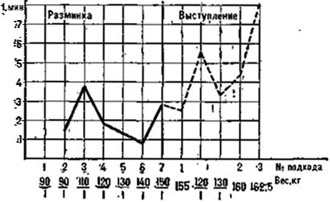
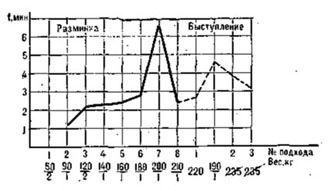
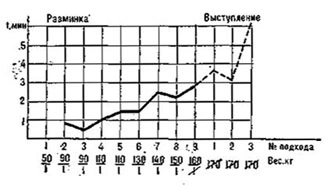
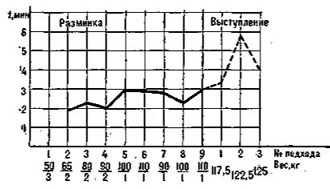
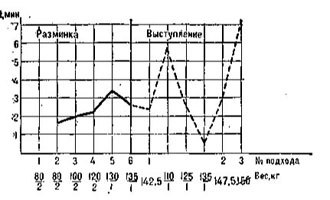
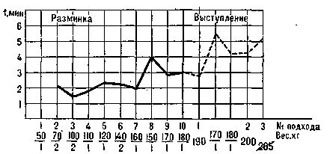
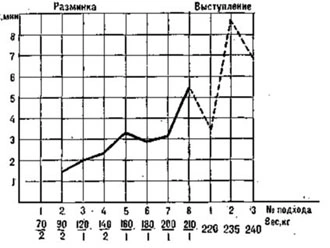
- This rhythm of readiness strongly affects success (Figs. 1–8).
- Typical interval: ~2 min (snatch), ~3 min (clean and jerk), lengthening attempt by attempt. Sharp swings signal insecurity (Figs. 1–3).
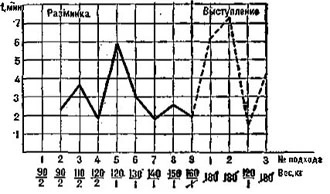
Fig. 1. V. Alekseev, snatch: warm-up 90–160 kg (160 missed), erratic intervals; attempts at 180 kg.
Case studies
- D. Rigert, snatch (Fig. 4): visibly tense, kept watching his rival R. Aleksandrov (Bulgaria) on the next platform. Intervals were normal, but he missed his last warm-up (160 kg) — very rare at this level, and ignored as a warning. He then failed 170 kg three times. Cause: form after his move to another class misjudged; opener set without regard to his individual pattern.
- V. Alekseev, snatch (Fig. 1): arrived early, careless and unfocused; erratic intervals; missed 160 kg in warm-up yet opened at 180 kg (declared 175 kg) — with the well-known result. Not ready for this level.
- Well-controlled rhythm and results: D. Núñez and Ya. Rusev (snatch), A. Zlatev and L. Taranenko (clean and jerk), Figs. 5–8.
Conclusion
Preparation for major meets must take into account each lifter's individual psychological behaviour under extreme physical and mental stress.