Equipment and apparatus
A Weightlifting Training Complex
English summary of Tyazhelaya Atletika. Ezhegodnik 1983 (Moscow: Fizkultura i Sport, 1983), pp. 63–65: the text is paraphrased, not translated; data tables are given in full with English labels; figures are the original images.
Purpose
- A barbell of constant weight leaves little room for extra force or speed accents, yet different parts of a lift need different force and contraction speed (Sokolov 1967; Vorobyov 1971; Zhekov 1971; Frolov 1976).
- Extends the authors’ earlier device (USSR inventor’s certificate No. 611623), which gives decreasing and increasing resistance within one lift (effect shown in Yu. T. Cherkesov’s candidate dissertation, 1979) but served only snatch and clean pulls. The complex adds squats, bends, presses and other exercises.
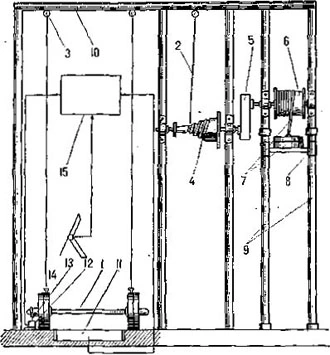
Design
- Control unit (1–10): the barbell cable (2) branches over overhead pulleys (3) to the plates and winds into the grooved thread of a cylindro-conical shaft (4). A step-up gearbox (5) couples the shaft coaxially to a drum (6), from which a weight (7) hangs on sliders (8) running in vertical guides (9); all mounted on a frame (10).
- The overhead pulleys and branched cable are what make the extra exercises possible.
- The gearbox cuts the weight’s travel and speed (less inertial effect on the athlete) and keeps cable 2 taut.
- Recording unit (11–15): strain-gauge platform, displacement and velocity sensor with a line to the bar, knee electrogoniometer, chart recorder. Described in earlier work: A. P. Bykov (Teoriya i praktika fizicheskoi kultury, 1966, No. 4, pp. 44–45); R. Ganiev (3rd All-Union conference “Electronics and Sport”, Leningrad, 1972, pp. 11–12); dissertations of A. A. Lukashev (1972), S. I. Lelikov (1975), V. M. Frolov (1976).
Suggested dimensions of the control unit
| Element | Size, mm |
| Frame height | 2500–2600 |
| Cylindro-conical shaft: diameter of the smaller base of the truncated cone | 25–35 |
| Cylindro-conical shaft: diameter of the larger base | 130–150 |
| Length of the grooved thread | 1500–1700 |
| Pitch of the grooved thread | 8–12 |
| Drum diameter | 130–150 |
Operation
- Start (e.g. snatch pull): weight hangs under the drum, cable 2 taut, sensor line fixed to the bar end; the lifter straps the goniometer to the knee and stands on the platform.
- Lift: the falling weight turns drum and shaft via the gearbox, winding cable 2; the recorder traces knee angle, ground reaction force and the bar’s vertical displacement and speed.
- Lowering the bar returns the weight and resets the machine.
- Modes: decreasing resistance — cable wound from the larger to the smaller cone diameter; increasing — the reverse. The shaft radius sets the resistance gradient.
Advantages
- Suitable for lifters of all levels.
- Variable resistance prevents speed and strength barriers and corrects force and speed in different parts of the movement.